
What Makes Wedding Dress Cleaning Different From Regular Dry Cleaning
Wedding dresses are harder to clean than most people expect going in. Not because the job cannot be done, but because doing it right requires a level of care and expertise that goes well beyond what a standard dry cleaner is set up for.
Wedding dress cleaning is its own area of expertise. The fabrics involved are more complex, the staining is different in kind, and the margin for error is much smaller. Here is a closer look at what actually sets it apart — and what to know before you hand the dress over to anyone.
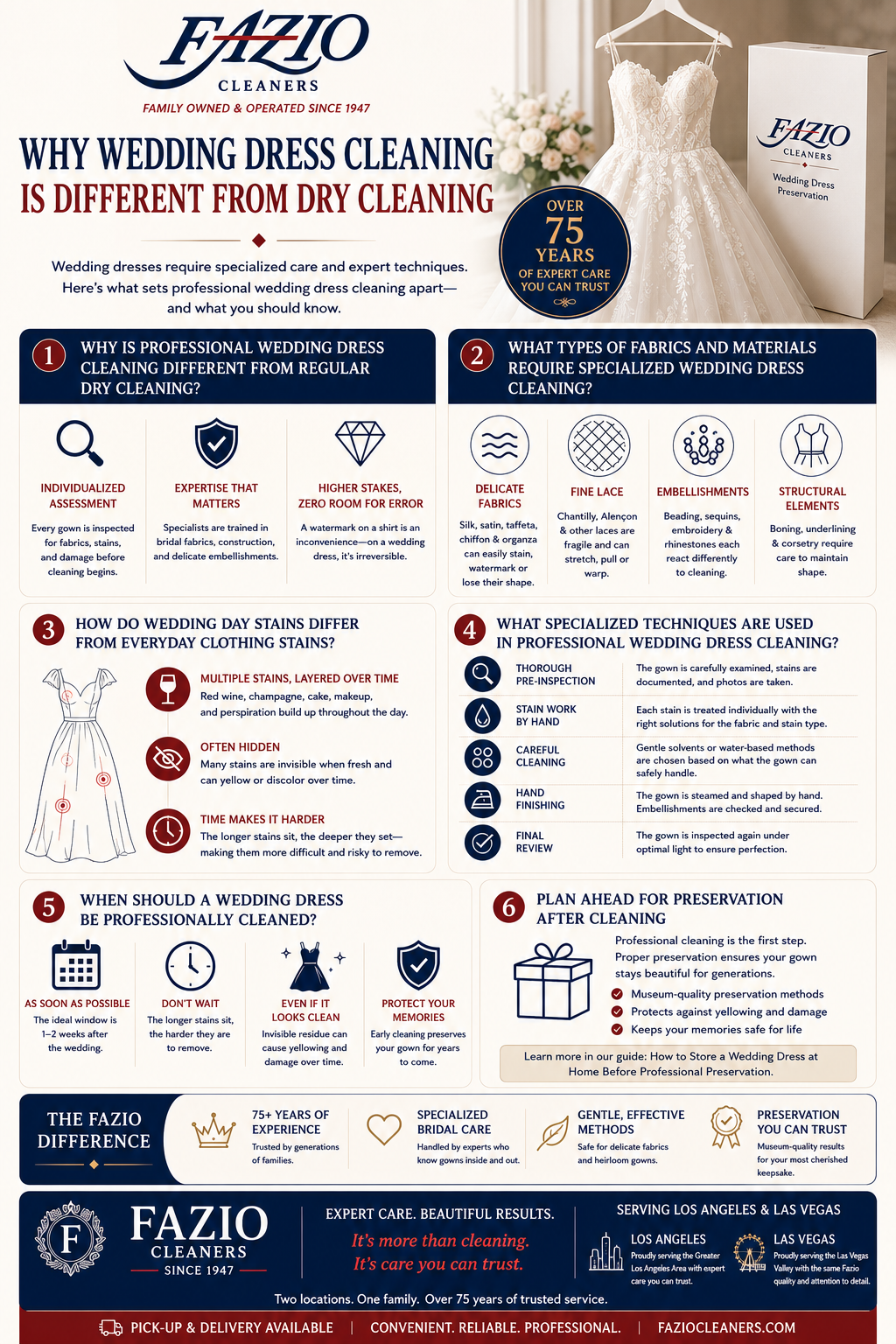
Why Is Professional Wedding Dress Cleaning Different From Regular Dry Cleaning?
The difference between standard dry cleaning and professional wedding dress cleaning comes down to training, care, and how seriously the work is taken. A conventional dry cleaner moves through garments at volume — the goal is speed and consistency across predictable items. A specialist who handles bridal wear operates differently from the very start.
Before any cleaning begins, a professional will look over the gown carefully: identifying every fabric, noting any existing damage or staining, and deciding which approach is right for the way that specific dress is built. No two gowns are handled the same way because no two gowns are put together the same way. At Fazio Cleaners, this kind of individualized attention is at the heart of our wedding dress cleaning and preservation service — developed over more than 75 years of caring for garments that cannot be replaced.
There is also the question of what is at stake. A shirt that comes back with a faint watermark is an inconvenience. A wedding dress with the same outcome is a loss that cannot be undone. That awareness drives every decision a qualified specialist makes — and it is noticeably absent from a general cleaning workflow.
What Types of Fabrics and Materials Require Specialized Wedding Dress Cleaning?
The challenge with most bridal gowns is not one tricky fabric — it is several of them, layered together and often finished with materials that do not respond well to the wrong treatment. Caring for a wedding dress properly means understanding how all of those elements work together, not just how to handle each one individually.
Silk is one of the most common concerns. Silk charmeuse, dupioni, and taffeta are all widely used in bridal construction, and all are easy to damage — a watermark, too much heat, or the wrong cleaning product can dull the finish permanently. Lace brings its own considerations: delicate styles like Chantilly or Alençon can pull or warp under pressure, and lace appliqués that have been glued rather than sewn may not survive moisture at all.
Embellishments complicate things further. Beading, sequins, embroidery, and rhinestones often appear together on a single bodice, each attached differently and each reacting in its own way to water and cleaning products. Then there are the structural pieces beneath the surface — boning, underlining, corset panels — which can shift or lose their shape if things get too hot or too rough. This is why wedding gown cleaning calls for the same depth of care as couture garment care: working on the outside without accounting for what is underneath is a reliable way to ruin a dress.
How Do Wedding Day Stains Differ From Everyday Clothing Stains?
Wedding day stains are tricky in ways that go beyond the obvious — they are layered, often hidden, and they get worse the longer they are left alone.
A single reception can leave a dress carrying red wine, champagne, chocolate cake, makeup, and perspiration. These do not arrive one at a time. They build up across the full stretch of the day, often settling into the fabric long before there is any visible sign of them. What looks like a small mark near the hemline might actually be several different things at once, each needing its own approach to address properly.
The bigger concern is the stains you cannot see at all. Residue from drinks and cake is often completely colorless when fresh. Many brides pack the dress away assuming it came through unscathed, only to find yellowed patches months later — by which point the staining has worked its way into the fibers and become much harder to lift without risking damage to the fabric. This is one of the main reasons professional wedding dress cleaning should happen soon after the wedding, not whenever it is convenient.
What Specialized Techniques Are Used in Professional Wedding Dress Cleaning?
Professional wedding dress cleaning is built around one idea: every choice is made for this specific dress, not pulled from a standard checklist. That said, most specialist cleanings follow a careful, consistent sequence.
Thorough pre-inspection — The gown is looked over closely before anything else happens. Stains are noted and photographed, and any areas that need extra attention are assessed before a single product is applied.
Stain work by hand — Each stain is treated individually using the right solution for both the type of stain and the fabric underneath. This is slow, deliberate work — and it has to happen before broader cleaning begins, otherwise the cleaning process itself can set the stains deeper.
Careful cleaning — Depending on what the gown is made of, the cleaning may involve gentle eco-friendly solvents, a controlled water-based process, or a combination of both. The method is chosen based on what the dress can handle, not what is most convenient.
Hand finishing — Once clean, the dress is steamed or pressed carefully by section, with embellishments checked and any loose trim secured along the way. Gowns are never sent through a standard press.
Final review — The finished gown is looked over one more time under good lighting to confirm everything has been addressed before it is returned or prepared for preservation.
When Should a Wedding Dress Be Professionally Cleaned?
Sooner than most brides think. The window for the most effective cleaning is roughly one to two weeks after the wedding — after that, staining that could have been straightforward to treat starts to become a more involved problem.
The reason is time. The longer things sit in the fabric — drink residue, food, body oils — the more settled they become. A stain that is easy to address at one week can require far more work at three months, and the more effort it takes to remove something, the greater the chance of affecting the fabric in the process.
This also applies to dresses that look clean. Invisible residue left behind will continue to work its way into the fabric over time, and what feels like a safe storage decision can quietly turn into damage that only shows up later. If you are thinking ahead to what comes after cleaning, our guide on how to store a wedding dress at home before professional preservation covers everything you need to know about keeping the gown in good shape until it is ready for long-term care.
Trust Your Gown to a Specialist
Your wedding dress deserves more than a standard dry cleaning drop-off. At Fazio Cleaners, our 75+ years of experience means we understand exactly how to care for bridal gowns — from delicate silk and lace to intricate beading and embroidery.
Our trained specialists assess each gown individually before any cleaning begins, using gentle techniques suited to the specific fabrics and staining involved. We will give you an honest evaluation of your dress and walk you through what we recommend — no pressure, just straightforward guidance.
Our convenient pick-up and delivery service means you do not have to leave home to get your gown the care it needs.
Contact Fazio Cleaners today or schedule a pickup to get started. With locations throughout Los Angeles and Las Vegas, we are here to help you protect your gown for the years ahead.